How Diagnostic Labs Can Automate Genome Reporting with a Secure SaaS Pipeline

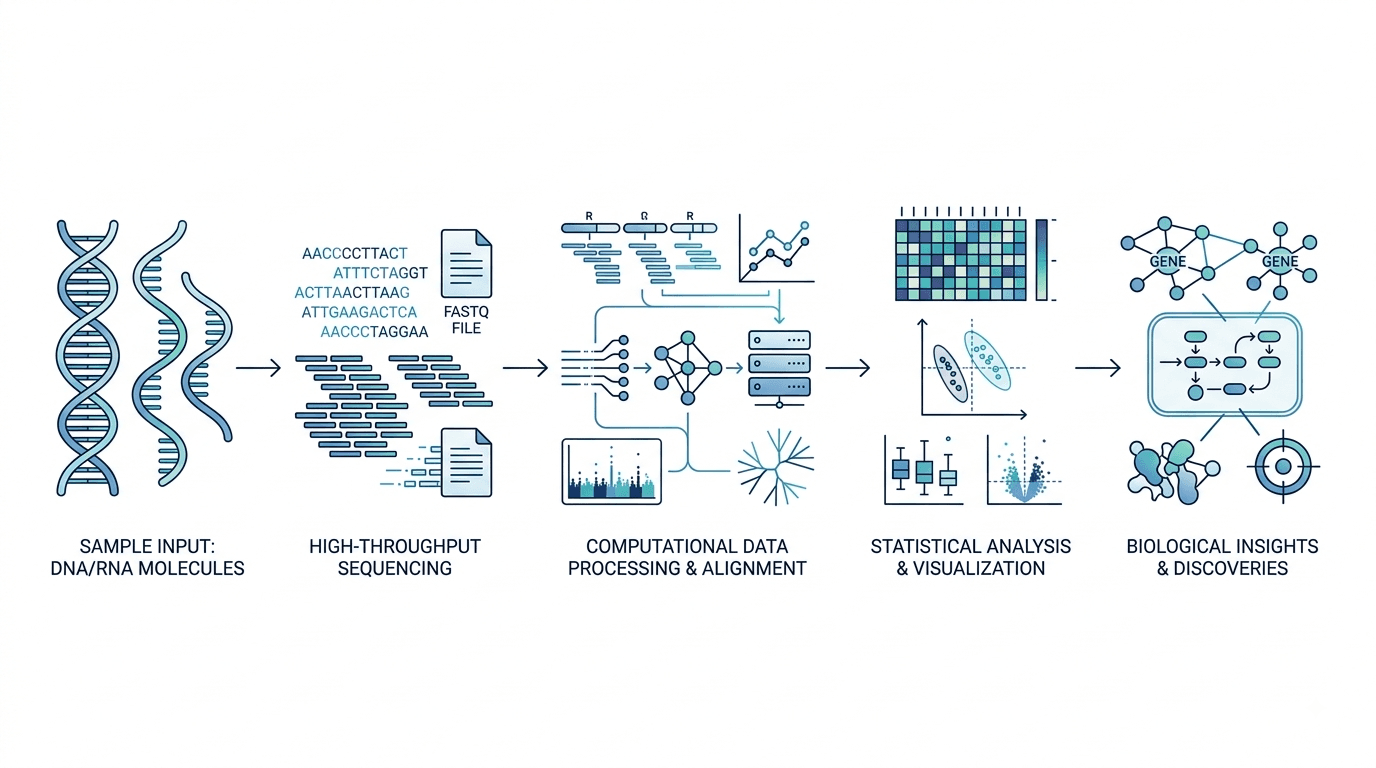
Sequencing is no longer the slow part — interpretation and report writing are. Here is how a secure, ACMG-aligned SaaS pipeline takes a lab from FASTQ to a signed, branded report without adding headcount.
An automated genome reporting pipeline is a system that takes raw sequencer output and produces a classified, clinician-signed, patient-readable report without a human touching a spreadsheet in between. For a diagnostic lab, turnaround time is increasingly determined not by sequencing speed, but by the capacity of the interpretation and reporting team
Ask a lab director where their genome reports lose time and almost nobody says sequencing. The instrument finishes overnight. What follows is the slow part: a bioinformatician runs the pipeline, exports a variant table, filters it in a spreadsheet, cross-checks a handful of databases, drafts a report in a word processor, and sends it to a clinician who marks it up in comments.
None of that is unskilled work. All of it is work that a pipeline should have already done, so the skilled part — the judgement call on a variant — is what your specialist actually spends their day on.
Key Takeaways
- Sequencing is rarely the bottleneck; variant interpretation and manual report assembly are, and both scale with headcount rather than with instruments
- Published turnaround ranges vary enormously — some labs commit to 7-day provisional results, others quote 3-4 weeks — and the gap is mostly pipeline maturity, not sequencing capacity
- Automated interpretation is measurably faster: one genetics centre reported cutting analysis turnaround by 75% after adopting an AI-assisted platform
- Automation does not mean unsupervised: final clinical sign-off remains human, with audit trails ensuring traceability under NABL and ISO 15189
- For Indian labs, population-specific reference data matter. Underrepresentation of many Indian populations in global databases can lead to more variants being classified as uncertain.
Where the time actually goes
Break a typical exome case into stages and the pattern is consistent:
| Stage | Typical effort | Scales with |
|---|---|---|
| Sequencing run | Overnight, unattended | Instrument capacity |
| Alignment + variant calling | Minutes to hours, automatable | Compute |
| Annotation + filtering | Hours, often manual | Analyst hours |
| Variant classification | Hours per difficult variant | Specialist hours |
| Report assembly + formatting | Hours per report | Analyst hours |
| Clinician review + sign-off | Minutes, if the report is good | Clinician availability |
The industry agrees on the sore point. Variant interpretation is widely described as laborious, time-consuming and fundamentally unscalable in its manual form — a single variant of uncertain significance with conflicting evidence can absorb hours of a specialist's attention.
What a secure SaaS pipeline replaces
The goal is not to remove people from the process. It is to remove the parts of the process that never needed a person.
- Ingestion that does not care which sequencer you bought.
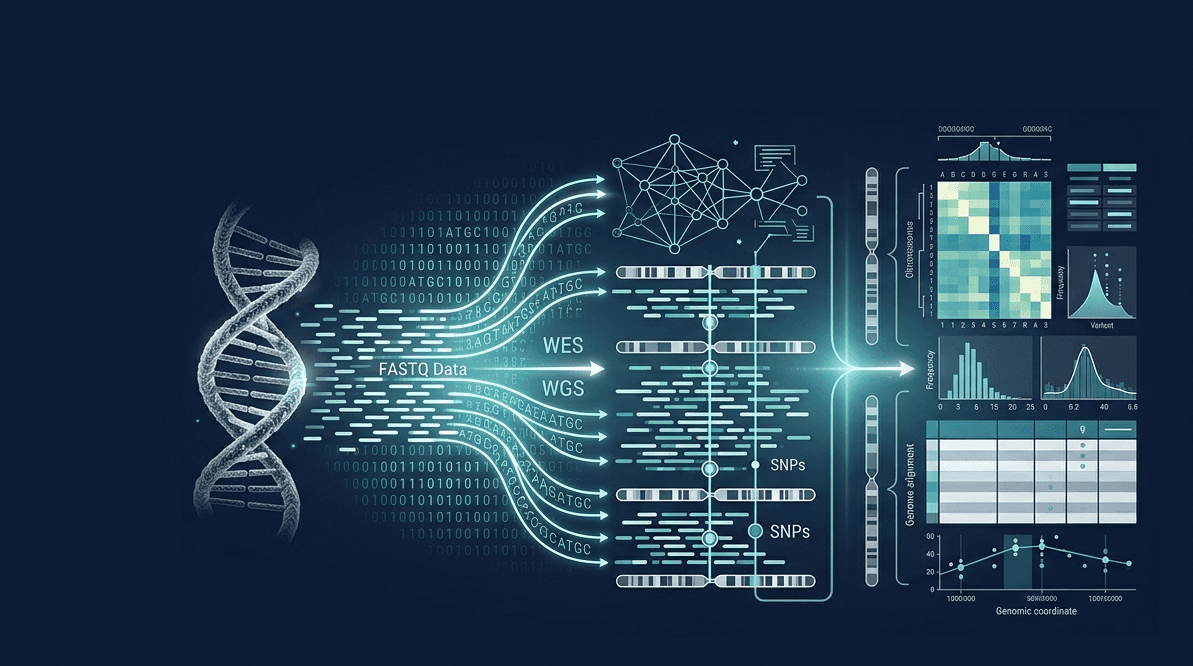
A pipeline should accept BCL or FASTQ from Illumina, MGI or Oxford Nanopore and carry it through to VCF and a report without vendor lock-in. Vendor-specific software may work for a single platform, but multi-platform laboratories benefit from workflows that integrate data consistently regardless of the sequencer
- Classification that follows the guideline, every time
ACMG/AMP classification is a rules framework, which means most of it is mechanisable: evidence codes applied consistently, the same way, on every case. Reproducibility here is a genuine quality problem — a survey of diagnostic laboratories found wide variation in variant classification despite ACMG guideline adoption. A pipeline that applies the criteria identically on every case removes an entire category of inter-analyst variation.
- Population context that reflects your patients
This one is specific to labs serving Indian populations. Allele frequencies drawn from reference databases where Indian samples are a fraction of a percent will over-call rare variants, which lands as an inflated VUS pile on your specialist's desk. Reweighting against Indian-population and lab-curated frequencies is not a nicety; it is the difference between a report with three variants to discuss and one with thirty.
- The report as an output, not a document
The last mile is where most automation projects stop, and it is where labs lose the most time. A tiered report — primary diagnostic findings, secondary and medically actionable (ACMG SF), carrier status, pharmacogenomics — assembled automatically, in your branding, with plain-language patient summaries alongside the clinical detail.
FAST5 / FASTQ → QC + alignment → variant calling → annotation↓ ↓instrument-agnostic ACMG evidence codes applied↓ ↓population-aware filtering → draft report → CLINICIAN SIGN-OFF → release↑the one gate that stays human
The part that makes it usable in a real lab
A pipeline that a NABL-accredited lab cannot defend in an assessment is a pipeline that will not be used. Three requirements shape the architecture more than any algorithm does:
- Audit trail on everything. ISO 15189 expects results to be handled through a system that manages workflow, quality and an audit trail for every sample processed. Every pipeline run, every classification decision, every sign-off — recorded, versioned, attributable.
- Confidentiality by construction. Patient confidentiality must be maintained at all times, and under India's Digital Personal Data Protection (DPDP) Act 2023 health data carries the full weight of consent, purpose limitation and breach obligations. Storage encrypted, access scoped by role, and no patient identifier travelling further than it needs to.
- Human sign-off, permanently. The clinician approves before release, and the system records who approved what, when. Automation earns its place by making that review fast — not by removing it.
A lab does not buy faster reports. It buys the ability to say yes to more referrals without hiring a second specialist it cannot find.
What we are building
Inferagen.ai is our clinical genomics platform, currently in active development. It supports eight analyses across three pipeline families—clinical exome interpretation, microbiome and metagenomics, and bulk RNA-seq—on both short-read (Illumina, MGI) and long-read (Oxford Nanopore) data. The platform combines ACMG-guided variant interpretation, Indian population-aware annotation, branded tiered reports, and a clinician sign-off workflow.
We are open to design-partner labs — which means your workflow shapes the product rather than the other way round.
Frequently asked questions
Does automating variant classification mean removing the clinician?
No. Classification is drafted automatically and consistently; release requires clinician sign-off, and the system records who approved what and when. The purpose is to hand the specialist a well-evidenced draft instead of a raw variant table, so their time goes to the judgement calls only they can make.
Will it work with our existing sequencers?
That is the design requirement. An instrument-agnostic pipeline ingests FASTQ from Illumina, MGI (single or paired-end reads) or FAST5/ FASTQ from Oxford Nanopore and carries it through to VCF and report. Labs that lock their reporting workflow to one vendor's software pay for it the day they add a second instrument.
How does this fit NABL / ISO 15189 accreditation?
It should strengthen the file rather than complicate it. Accreditation expects workflow, quality and audit trail management for every sample processed, plus documented, version-controlled procedures. A pipeline that logs every run, classification and approval produces that evidence as a by-product of doing the work.
What about patient data protection?
Health data under India's DPDP Act 2023 carries consent, purpose-limitation and breach-notification obligations, on top of the confidentiality duty ISO 15189 already places on the lab. Practically: encryption at rest and in transit, role-scoped access, identifiers minimised through the analysis stages, and a retention policy that matches your regulatory obligations.
See it on your own data
The fastest way to judge a pipeline is to watch it run a case you already know the answer to. We will walk you through ingestion, classification, the sign-off gate, and the report your clinicians would actually receive — request a pipeline demo, or talk to us about becoming a design-partner lab.
Further reading
- GeneDx — exome sequencing turnaround times
- Broad Clinical Labs — clinical whole genome sequencing with interpretation
- Tackling the bottleneck of variant interpretation (enGenome)
- Illumina Emedgene — reported 75% reduction in analysis turnaround
- Survey of exome variant analysis and clinical reporting among diagnostic laboratories
- NABL 112A — specific criteria for medical testing laboratories